

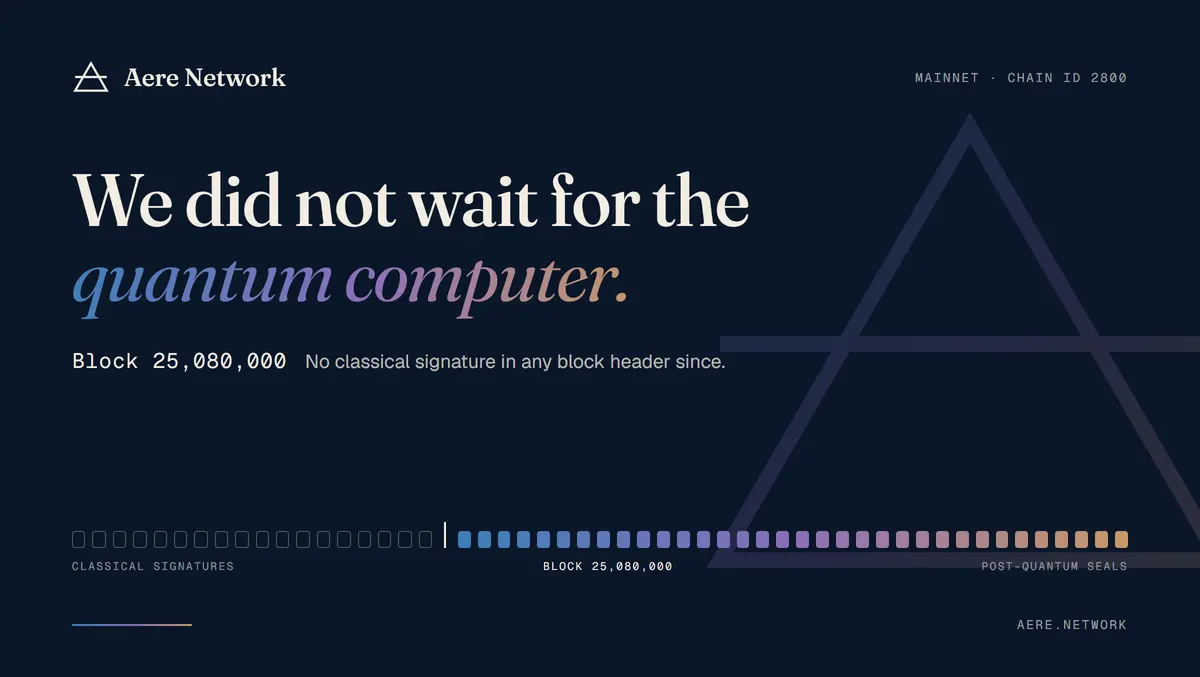
Aere replaces blockchain signatures with quantum-safe seals
Sat, 28th Nov 2026 (Today)
Aere Network has replaced the classical digital signatures on its live blockchain with post-quantum signatures. The transition was completed through six protocol updates over 31 days without stopping the chain.
The final step came at block 25,080,000, when the field that had held classical signatures in each block header was left empty and replaced with Falcon-512 seals. The network continued operating normally, and the next block arrived 0.6 seconds later.
The move shifted several core parts of the blockchain away from cryptography widely used across blockchains, banking systems and websites. The changes covered user transactions, validator identities, consensus votes and block headers, with each stage introduced at a specific block number on the public network.
Under the sequence of updates, native transactions authorised by ML-DSA were introduced at block 19,900,000. At block 20,836,228, validators stopped being identified by classical addresses and moved to post-quantum keys. At block 24,300,000, consensus votes began to count only when they carried a verified post-quantum seal. The final step at block 25,080,000 applied Falcon-512 to every block header.
Every 32nd block now carries a certificate of the validator quorum under its own hash. Every 128th block carries that quorum twice using two different cryptographic schemes, reducing reliance on any one mathematical approach.
Why signatures matter
Aere framed the shift as a response to the long-term risk quantum computing poses to current public-key cryptography. Much of the debate has focused on encrypted data that could be collected now and decrypted later. Blockchain systems face a different problem because signatures are used to verify identity and confirm the validity of records.
If a validator's signing key could be derived from public information in future, an attacker could in principle sign as that validator. That would cast doubt on the integrity of the ledger, rather than merely exposing confidential data.
NIST published post-quantum replacement algorithms in 2024 and has proposed retiring current signature systems after 2030. Much of the wider sector has so far focused on transition plans rather than live deployments.
"Everyone says quantum is coming," said Liviu Hrenaru, Founder and Chief Executive Officer of Aere Network. "We stopped saying it and removed the signatures it breaks. On a live network, in public, one block at a time."
Verification push
Aere also disclosed details of the software used by validators and said the build process can be checked independently. It published what it described as the full recipe for the validator program, including the upstream commit and each modification as a patch.
Built from that material alone, the resulting software matches what runs on the validator set class for class, covering 3,662 classes. Aere also said an independently written second client runs in the same validator set under the same rules.
The group added that, as of 24 November, the standard developer libraries ethers, viem and web3.js can read the network's post-quantum transactions without modification.
Hrenaru set out the company's position in direct terms. "I do not want to be believed. I want to be checked," he said. "Any company can write the word quantum on a website. We publish the verifier. If another network makes the claim we make, the test for them is the same as for us: run it."
Founder profile
Hrenaru, who grew up in Romania and later built businesses in Monaco, was recently named Post-Quantum Technology Business Leader of the Year in the 2026 Global CEO Excellence Awards by CEO Monthly. He linked that personal recognition to the broader argument Aere is making about inspectable systems and public verification.
"I did not come from a famous laboratory," Hrenaru said. "I came from a small town with a computer and a stubborn idea: that trust should be something you can check. Everything we build follows from that."
Broader market
Aere argued that the same transition challenge now faces banks, governments and software providers that depend on classical cryptographic keys. In its view, the task is to identify where those keys are trusted, replace them without interrupting service and provide evidence that the new system works as claimed.
It has released open tools including a gateway for hybrid post-quantum encryption, a key manager, a source-code cryptography inventory and a scanner that reports which cryptographic methods a public hostname currently negotiates. It also offers verification, notarisation and timestamping through Aere Cloud, with each response anchored to a block on its chain.
The blockchain itself is an EVM-compatible Layer 1 network with chain ID 2800, deterministic finality and a fixed supply of 2.8 billion AERE set at genesis. According to Aere, the next phase of its migration is already written and in testing and will remove classical signatures from validator-to-validator messages.
"The internet was built on trust that a quantum computer will break," Hrenaru said. "Somebody has to rebuild that trust before it breaks, not after. That is the company we are building: the trust layer of the digital world."