

OpenAI launches GPT-Rosalind for life sciences research
Sat, 18th Apr 2026
OpenAI has introduced GPT-Rosalind, a new artificial intelligence model for life sciences research. It is being offered as a research preview to qualified customers in the United States.
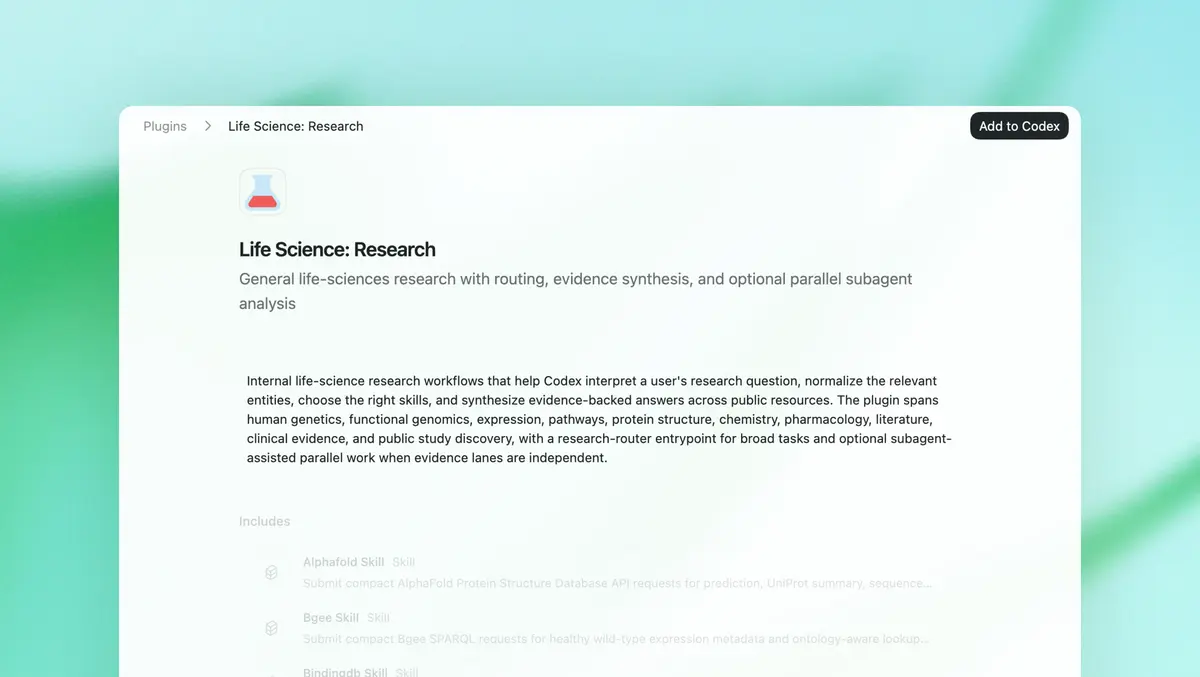
The system is designed for work across biology, drug discovery and translational medicine. It is available through ChatGPT, Codex and the API under a trusted access programme, while a separate Life Sciences research plugin for Codex is being released more broadly.
GPT-Rosalind is aimed at scientific workflows that rely on literature, specialist databases, experimental data and multiple stages of analysis. Researchers often face fragmented, time-consuming processes in the early stages of discovery, when teams are identifying biological targets, testing hypotheses and planning experiments.
The launch marks a more tailored push by OpenAI into research-intensive sectors. The company named pharmaceutical groups Amgen and Moderna, research organisation the Allen Institute, and laboratory supplier Thermo Fisher Scientific among those working with the model. It also said it is working with other pharmaceutical, biotechnology and research customers.
Benchmarks tested
OpenAI said GPT-Rosalind was assessed on a set of public and industry-focused benchmarks covering chemistry, protein science, genomics and bioinformatics tasks. The tests were intended to measure reasoning across molecules, proteins, genes and pathways, as well as the model's use of scientific tools and databases in multi-step tasks.
On BixBench, which OpenAI described as a benchmark built around real-world bioinformatics and data analysis, GPT-Rosalind delivered the strongest published score among models with publicly available results, according to the company. On LABBench2, a benchmark covering tasks such as literature retrieval, database access, sequence manipulation and protocol design, the model outperformed GPT-5.4 on six of 11 tasks, OpenAI said.
OpenAI highlighted CloningQA as the area with the largest gain in that benchmark. The task involves designing DNA and enzyme reagents for molecular cloning protocols.
It also said it worked with Dyno Therapeutics on a separate evaluation involving RNA sequence-to-function prediction and generation using unpublished sequences. In that test, best-of-ten model submissions in Codex ranked above the 95th percentile of human experts on the prediction task and around the 84th percentile on the sequence generation task, based on comparisons with 57 historical expert scores, according to OpenAI.
Tool access
Alongside the model, OpenAI is releasing a Life Sciences research plugin for Codex that connects users to more than 50 public databases, literature sources and biology tools. The package is intended to support common research tasks including protein structure lookup, sequence search, literature review and public dataset discovery.
Eligible enterprise users can use the plugin with GPT-Rosalind, while other users can use it with OpenAI's main models. OpenAI said the package is intended as an orchestration layer for broader, multi-step research questions across areas including human genetics, functional genomics, protein structure, biochemistry and clinical evidence.
Access to GPT-Rosalind itself is restricted to qualified enterprise customers in the US, with checks based on intended use, governance, safety oversight and controlled access. Participating organisations must be conducting legitimate scientific research with public benefit, maintain compliance and misuse-prevention controls, and restrict access to approved users in secure environments, OpenAI said.
Name and scope
The model is named after Rosalind Franklin, whose work contributed to the discovery of DNA's structure. OpenAI described GPT-Rosalind as the first release in a broader life sciences model series.
The company framed the product around early-stage drug research, where target discovery and regulatory approval can take 10 to 15 years in the US. Improvements in early research stages can affect downstream target selection, biological hypotheses and experiment quality, it said.
OpenAI did not provide commercial pricing for the preview period. It said use during the research preview would not consume existing credits or tokens, subject to abuse guardrails, and that pricing and wider availability would be disclosed later.
"Today, we're introducing GPT‐Rosalind, our frontier reasoning model built to support research across biology, drug discovery, and translational medicine," OpenAI said.