

Three technology myths CIOs should stop believing
Thu, 1st Oct 2026 (Today)
Enterprise technology has always been susceptible to hype cycles. But the arrival of generative and Agentic AI has amplified an old problem: organisations are encouraged to make major technology decisions before they have clearly defined the business problem they are trying to solve.
For CIOs, separating genuine transformation from industry mythology has therefore become increasingly important.
There are three myths in particular that deserve to be challenged.
Myth one: Software has a shelf life.
We have become accustomed to talking about software as though it were a physical asset that inevitably wears out. Whilst that is true for hardware, where components fail and newer generations deliver better performance, software is different.
Software is codified business logic. If an application continues to execute a business process effectively, being ten or even 20 years old does not automatically make that software obsolete.
The financial services industry demonstrates this particularly well. Banks have expanded from branches and ATMs to online and mobile banking and digital payments, while in many cases, longstanding core systems have continued to operate underneath.
The important question is therefore not simply: How old is our software?
It is: Does it still perform the business function we require?
More often than not, enterprise software in use today was purchased under a perpetual license, which is difficult to obtain today. From a pure financial perspective, organisations are sitting on a very valuable asset that can be enhanced with third-party services and software at a fraction of the cost of replacement. The myth exists for the benefit of the vendors.
Myth two: AI itself is a business outcome.
Over the past few years, organisations have launched countless AI pilots and proofs of concept. Yet many have struggled to demonstrate measurable financial returns. One reason is that we frequently confuse end-user productivity with operational improvement.
AI can undoubtedly make employees more productive. It can help people write documents, summarise information, search for knowledge or complete everyday tasks more quickly. These are all valuable capabilities.
But productivity improvements are not necessarily the same as measurable improvements to business performance. The greater opportunity lies in applying AI to operational processes: reducing the time required to onboard a customer, process an invoice, manage inventory, close the books or work with a supplier.
These are often less glamorous than launching another AI assistant, but they are where organisations can begin connecting AI investment to measurable outcomes.
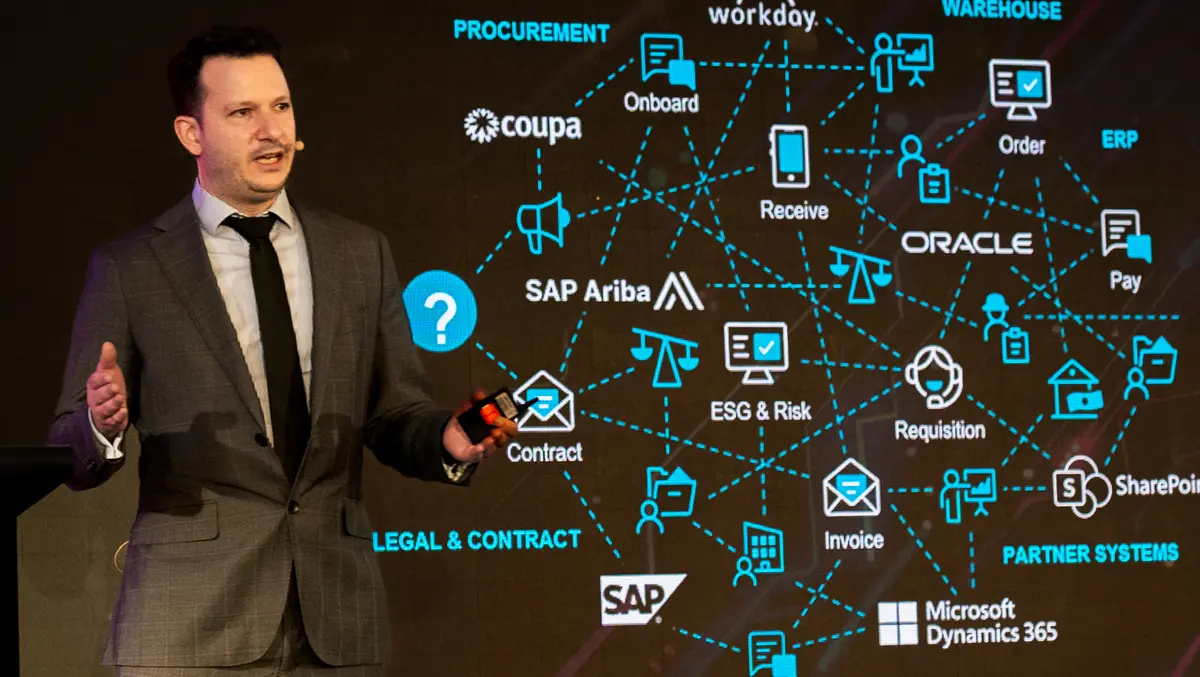
And importantly, many of these processes touch multiple systems of record. That means organisations need to understand the business process first and then determine how AI can improve it – rather than starting with an AI product and searching for somewhere to deploy it.
Myth three: You need to upgrade your ERP to take advantage of AI.
This is perhaps the most consequential assumption of all.
Organisations are increasingly being told that accessing the latest AI capabilities requires migrating to the newest cloud version of their enterprise software.
But Agentic AI potentially turns that logic on its head.
The question CIOs should be asking isn't whether their ERP is "AI compatible". It is whether a business process can be executed or improved using AI. If it can, there are numerous ways of connecting AI to the systems and data required to perform that process.
In fact, enterprise architecture has already been moving away from the monolithic ERP model. Organisations increasingly use specialist platforms for CRM, HR, service management, payroll, expenses and other functions. As a result, innovation is already occurring across an ecosystem of applications rather than within a single enormous system.
Agentic AI could accelerate that transition.
Instead of every application being the place where users both store information and perform work, enterprise applications can increasingly become systems of record, while orchestration and decision-making occur across them.
That has profound implications for technology strategies.
Rather than automatically replacing functioning systems because a vendor's roadmap says it is time, CIOs have an opportunity to take greater control of their architecture. They can preserve systems that continue to perform effectively, introduce best-of-breed technology where it delivers genuine value, and invest in AI around the business processes that matter most.
Artificial intelligence represents a significant architectural shift. But that makes it more, not less, important to challenge conventional technology wisdom.
The organisations that benefit most won't necessarily be those that upgrade first. They will be those that understand the business outcome they want to achieve and build their technology strategy around it.